
Louisville STR Registration 2026: Full Compliance Guide
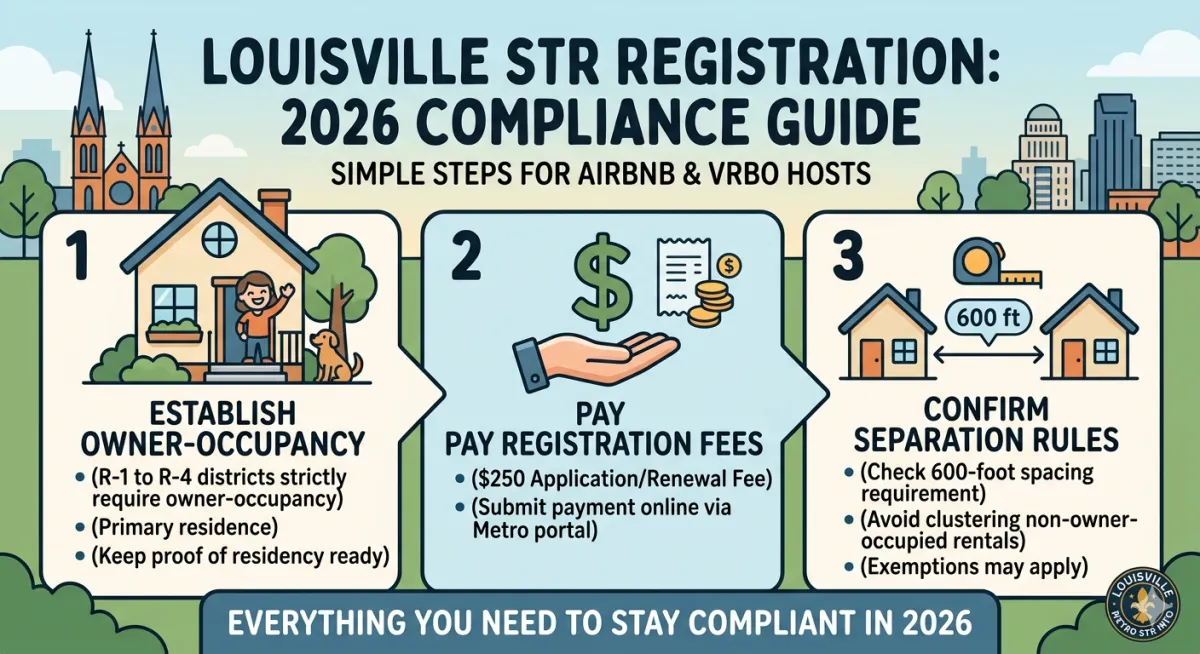
Louisville Short Term Rental Registration: The 2026 Compliance Guide for Airbnb Hosts
Overview
Louisville short term rental registration is mandatory, and the rules are stricter than most new hosts expect. Every STR must register annually with the Office of Planning at a $250 fee, and non-owner-occupied properties must maintain a 600-foot separation from other registered short-term rentals. Owner-occupancy generally has to be established for at least six months before applying. Failure to register results in fines, and listing an unregistered rental on Airbnb or VRBO is independently enforceable, so advertising a property you have not registered is its own violation. This guide walks through who must register, the exact steps, and the pitfalls that catch Louisville hosts off guard.
Who Needs to Register a Louisville STR
The owner-occupancy 6-month requirement
Louisville draws a hard line between owner-occupied and non-owner-occupied rentals. To register as owner-occupied, you generally need to have lived in the property as your primary residence for at least six months. Owner-occupied status unlocks more flexibility, so understanding which category you fall into shapes everything from where you can operate to how close you can be to other rentals.
Non-owner-occupied STR rules
If you do not live in the property, you are a non-owner-occupied operator, and the rules tighten. The 600-foot separation requirement and additional zoning scrutiny apply most heavily to this category. For investors running dedicated rental properties, this is the bucket you will almost always fall into, and it is where compliance planning matters most.
HOA and zoning overlay considerations
City registration is not the only layer. Homeowners associations and neighborhood zoning overlays can impose their own restrictions or outright bans on short-term rentals. A property can satisfy every city requirement and still be blocked by an HOA covenant, so checking both before you buy or list is essential.
The Louisville STR Registration Process Step-by-Step
Office of Planning application
The process starts with an application to the Louisville Office of Planning, including the $250 registration fee and documentation establishing your eligibility. This is where owner-occupancy status and the separation requirement are evaluated. Submitting a complete, accurate application the first time is the difference between approval in weeks and months of back-and-forth.
Louisville Metro Revenue Commission registration
Beyond planning approval, you register with the Louisville Metro Revenue Commission to handle the tax side of operating. Short-term rental income is taxable, and the city expects operators to be set up properly before collecting revenue from guests.
Transient Room Tax and Occupational License Tax setup
Louisville STRs are subject to the Transient Room Tax on guest stays, and operators may also owe Occupational License Tax on rental income. Setting these up correctly from day one keeps you out of trouble at tax time and avoids penalties that compound quietly while you focus on bookings.
Common Compliance Pitfalls and How to Avoid Them
600-foot separation rule and waiver limits
The 600-foot separation rule means a non-owner-occupied STR generally cannot operate within 600 feet of another registered short-term rental. In dense, popular neighborhoods this can disqualify a property entirely. Checking proximity to existing registrations before you purchase is one of the most overlooked steps in Louisville STR investing.
12-occupant maximum and how it is calculated
Louisville caps occupancy, with a common ceiling around 12 guests depending on the property, and the count is based on the home's configuration rather than your optimistic listing. Advertising more capacity than you are permitted is a fast route to a complaint and an enforcement action.
Advertising an unregistered STR
Listing a property before it is registered is independently enforceable, meaning the advertisement itself is a violation regardless of whether you have hosted a single guest. Many new hosts list first and register later and learn this the hard way. Register before you publish.
Frequently Asked Questions
How much does it cost to register a short term rental in Louisville?
The annual registration fee with the Office of Planning is $250. On top of that, operators should budget for the Transient Room Tax on guest stays and potential Occupational License Tax on income. The registration fee itself is modest, but the full compliance picture includes the ongoing tax obligations.
How long does Louisville STR registration approval take?
Approval timelines vary based on application completeness, property type, and whether any zoning or separation questions arise. A clean owner-occupied application moves faster than a contested non-owner-occupied one. Submitting complete documentation up front is the single best way to shorten the wait.
Can I appeal a denied STR registration in Louisville?
Yes, denials can generally be appealed through the city's established process, often before the Board of Zoning Adjustment depending on the grounds for denial. The strength of an appeal usually depends on the specific reason for denial, such as a separation conflict or zoning issue. Having documentation ready improves your odds.
What is the Transient Room Tax in Louisville?
The Transient Room Tax is a tax applied to short-term lodging stays, including STRs, and operators are responsible for collecting and remitting it. It functions similarly to a hotel occupancy tax. Setting up collection correctly from your first booking keeps you compliant and avoids back-tax surprises.
Zenstays manages full-service STRs in Louisville with compliance and licensing handled at no extra cost. Schedule a free call www.myzenstays.com to get started.


